

Close Menu
Insights Wire DailyInsights Wire Daily
    What's Hot

    Politics Home Article | Who Are The Influencers Being Signed Up To Promote Reform UK?

    September 13, 2026

    Palantir Foundry and cuOpt drive NVIDIA supply chain allocation

    September 13, 2026

    Here’s why the Enbridge stock is in a strong downward trend

    September 13, 2026
    Insights Wire DailyInsights Wire Daily
    • Business
    • Politics
    • Investing
    • Stocks
    • Best Savings Accounts
    Insights Wire DailyInsights Wire Daily
    Home»Business»Astronomers Discover the Existence of a Black Hole Star
    Business

    Astronomers Discover the Existence of a Black Hole Star

    August 17, 2026
    Astronomers Discover the Existence of a Black Hole Star
    Share
    Facebook Twitter LinkedIn Pinterest Email

    When Soundgarden Wrote “Black Hole Sun,” they may have inadvertently been onto something.

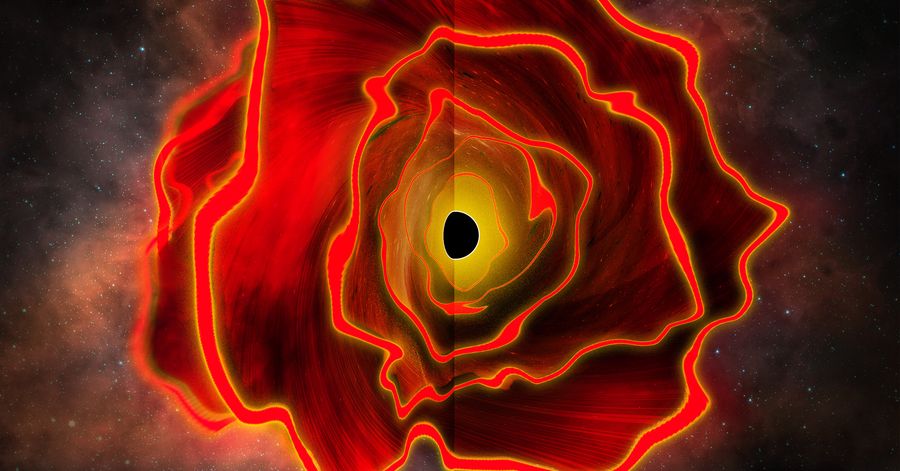
    In a new paper in Nature, scientists have chronicled a “black hole star” that’s the size of our solar system and glows bright red in the depth of space. The findings are based on observations from the James Webb Space Telescope, which continues to change how astronomers think about the cosmos.

    Researchers focused on some of the most distant observable phenomena in the universe, which appear to be something like a star in disguise. Based on the light they emit, they appear to share some characteristics with giant stars, but astronomers suspect they are actually black holes shrouded in an extraordinarily dense and luminous gas.

    These hypothetical objects have been dubbed black hole stars, and the new research, published Wednesday, lays out the case for them.

    The signal that’s at the center of the study comes from a time when the universe was just 660 million years old. (It’s now almost 14 billion years old.) In the JWST images, the object appears as one of the many bright, reddish spots that the telescope has found in the early universe.

    Examples of the famous and puzzling red spots in the early universe.

    Photograph: NASA, ESA, CSA, STScI, Dale Kocevski (Colby College)

    From a distance of billions of light-years, this phenomenon appears to be a gigantic star. But the object, known as MoM-BH*-1, has a few curious properties. It emits about 100 billion times more energy than any star could produce through nuclear fusion, according to the team. Even for the era in which it formed—during the early universe—it is an extremely bright object.

    Furthermore, part of its light abruptly disappears. Stars can produce a similar signal when their atmospheres absorb certain wavelengths, but in MoM-BH*-1, the effect is too intense to be explained as normal star behavior. Researchers believe that an enormous amount of extremely dense gas is absorbing that light.

    These clues led scientists to the black hole star hypothesis. At the center of MoM-BH*-1, there would be a black hole devouring matter and releasing enormous amounts of energy. Surrounding it, a massive gas envelope. The energy would pass through that gas before escaping into space and, in the process, would acquire some of the characteristics we would normally expect to find in starlight.

    The hypothesis could help address another mystery uncovered by the JWST. The telescope finds, with surprising frequency, small red spots in the early universe whose origins remain uncertain. They don’t fit neatly into the usual categories of objects in deep space. Scientists have put forward a number of explanations, including that they’re compact galaxies teeming with stars, black holes hidden by dust, and systems completely different from those we observe in the present-day universe.

    Previous ArticleKlarna stock has crawled back ahead of earnings: buy, sell, or hold?
    Next Article Synchrony Financial Partners With OpenAI To Enable In-Chat Shopping

    Related Posts

    Palantir Foundry and cuOpt drive NVIDIA supply chain allocation

    September 13, 2026

    Husqvarna Gets FCC Conditional Approval for Advanced Robotic Lawn Mowers in the US

    September 12, 2026

    OpenAI Wants to Know if an AI Industry Slowdown Would Even Be Legal

    September 11, 2026

      Subscribe to Updates

      Subscribe to our newsletter for early access to new products, exclusive deals, and exciting updates. Don't miss out! Our subscribers are always the first to hear about limited-time offers and new arrivals. Plus, you'll get sneak peeks and bonus content that adds value to your experience.

      By opting in you agree to receive emails from us and our affiliates. Your information is secure and your privacy is protected.

      Top Posts

      Politics Home Article | Who Are The Influencers Being Signed Up To Promote Reform UK?

      September 13, 2026

      Here’s why the Enbridge stock is in a strong downward trend

      September 13, 2026

      24-year-old charity giant quietly closes 190 stores

      September 12, 2026

      InsightsWireDaily is a digital news blog covering the latest updates in crypto, global economy, and investing. We focus on clear, timely insights to help readers stay informed and understand market trends without unnecessary complexity.

      Letest News

      Politics Home Article | Who Are The Influencers Being Signed Up To Promote Reform UK?

      September 13, 2026

      Palantir Foundry and cuOpt drive NVIDIA supply chain allocation

      September 13, 2026
      LEGAL INFORMATION
      • Contact us
      • Terms & Conditions
      • Privacy Policy
      Copyright © 2026 insightswiredaily.com | All Rights Reserved

      Type above and press Enter to search. Press Esc to cancel.